
DVV International Guatemala
Booth number: 08
www.dvv-international.mx/paises/guatemala
About us
DVV International Guatemala
Overview
DVV International, the Institute for International Cooperation of the German Adult Education Association (DVV), has been active in Guatemala since 1995. In 2023, the organization established a country office in Guatemala City to strengthen its on-the-ground presence and coordination.
Context and Challenges
Guatemala faces significant educational challenges. More than half of the working-age population has only completed primary school or has no formal education at all. The national illiteracy rate was reported at 16.6% in 2022, with the rate among women reaching as high as 20.5%. Access to quality youth and adult education is particularly difficult for those in rural areas, women, and indigenous groups due to insufficient financial resources and a lack of infrastructure.
Key Achievements
Through its work and the efforts of its partners, DVV International has helped lay the foundation for a non-formal Adult Learning and Education (ALE) system in Guatemala. A notable milestone is the support in establishing a Vice-Ministry for Extracurricular and Alternative Education within the Ministry of Education, which now has its own directorate for extracurricular education.
Main Focus Areas
Policy Advice: The work focuses on strengthening a national understanding of education policy. Within the framework of "Migration, Education and Development" (MBE), DVV International aims to anchor ALE programs that address the needs of disadvantaged groups. It also works to improve cooperation between state institutions and civil society.
Professionalisation of ALE Providers: A central goal is ensuring the sustainable qualification of adult educators. The organization promotes the establishment of professional training and further education courses. It also fosters the exchange of experience and information in the cross-border region of Mexico and Guatemala.
Educational Programmes for Disadvantaged Groups: DVV International supports high-quality educational opportunities with a special focus on young people and the non-formal education sector. A key goal is to enable disadvantaged groups—especially women, indigenous people, and migrants—to participate more actively in social and economic life through lifelong learning.
Key Partners
DVV International collaborates with a broad range of partners in Guatemala, including:
Government: The Ministry of Education (specifically the Department of Extracurricular Youth and Adult Education, DIGEEX) and the National Literacy Committee (CONALFA).
Civil Society: Fundación Tierra Nuestra and PRODESSA (Proyecto de Desarrollo Santiago).
Academic: The Latin American Faculty of Social Sciences (FLACSO), the branch of the National University of San Carlos (CUNOROC), the Guatemalan Institute for Radio Distance Education (IGER), and the private university LANDIVAR.
Cross-Border Cooperation
A key aspect of the work in Guatemala is cross-border cooperation with Mexico. This collaboration focuses on bilingual education for indigenous groups and addressing issues related to (cross-border) migration. DVV International plays a coordinating role, bringing together the Guatemalan Ministry of Education and the Mexican Institute for Adult Education (ICHEJA) to share methodologies and develop joint programs.
Address
32 Av. 5–79 Zona 11, Residenciales V
01011 Ciudad de Guatemala
Guatemala
E-mail: zaghi@dvv-international.mx
Phone: +502 3678 9587
Internet: www.dvv-international.mx/paises/guatemala
Contact person:
Dinno Marcelo Zaghi García
Licenciado
E-mail: Zaghi@dvv-international.mx
Products & Services
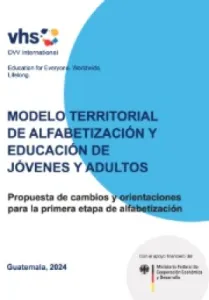
1. Territorial Model for Youth and Adult Literacy and Education
A comprehensive framework designed to implement literacy and adult education programs from a territorial perspective. This model takes into account local needs, cultural contexts, and geographic particularities, promoting the active participation of municipal governments, community organizations, and educational institutions. Its goal is to ensure that youth and adult education interventions are relevant, accessible, and sustainable at the local level.
2. Curriculum GlobALE for Latin America (2025)
A regional adaptation of the Global Curriculum for Adult Learning and Education (GlobALE), developed specifically for the Latin American context. This 2025 edition integrates regional pedagogical approaches, local realities, and the specific challenges of adult educators in Latin America. It serves as a competency-based framework for the professional development of adult educators, strengthening the quality of teaching and learning processes in non-formal education settings.
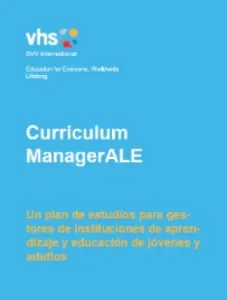
3. Curriculum ManagerALE
A specialized curriculum designed for the training and professional development of managers and administrators of adult learning and education programs. This curriculum equips educational managers with competencies in planning, monitoring, evaluation, resource management, and educational leadership. It aims to strengthen institutional capacities and improve the effectiveness and sustainability of adult education initiatives.
4. Educational Model for the Non-formal Education Subsystem
An official educational framework developed for the non-formal education subsystem in Guatemala. This model establishes the pedagogical principles, curricular guidelines, and assessment strategies for extracurricular youth and adult education. It is aligned with the national education system and aims to provide flexible, relevant, and quality educational opportunities for populations that have been excluded from the formal schooling system.
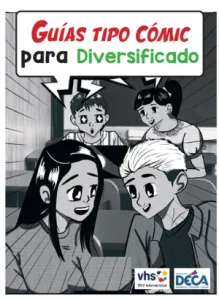
5. Comic-Based Integrated Project Guides
Innovative educational materials that use comics as a pedagogical tool to integrate learning across multiple subjects. These guides are designed for youth and adult education contexts, presenting thematic content through illustrated narratives, dialogues, and visual scenarios. They facilitate engagement, comprehension, and retention of complex topics, making learning more accessible and appealing for diverse populations, including those with limited literacy skills.